The Budapest issue
Budapest in September for a First Visit That Isn't Rushed
Three or four unhurried days in Budapest, while the outdoor pools are still warm, the queues have thinned and it is still light at eight.

By Marek NovákNeighbourhoods, baths and the slow way round

September in Budapest is the month the city hands back to people who want to walk it. The outdoor pools in City Park still hold their heat while the air over the Danube has cooled to something you can spend a whole day in, and the crowd pressed against the Parliament railings in July has thinned to a queue with a visible end. For a first visit this is the easy window: warm enough for a rooftop tub after dark, cool enough to climb Castle Hill without regretting it.
The shape of a September day
Sunset moves fast this month, from a little after 19:30 on the first to around 18:45 by the thirtieth. That one fact reorganises the day in your favour. An evening river trip or a rooftop drink lands at a normal hour rather than close to midnight, which means you can do a proper day of walking and still see the city lit without turning it into a late night.
Afternoons often sit in the low twenties Celsius; mornings and evenings ask for a layer, and by the last week of the month a jacket is not optional after dark. Rain comes in short bands rather than all day. Outdoor terraces, the bath complexes and the hilltop viewpoints all work, though the warm-water pools are more pleasant than the cold ones, and the walk between the two is where you feel the change.
Three full days is enough to see Budapest without hurrying. Four lets you add a day trip and keep one morning entirely unplanned, which is the part most first-timers skip and later wish they had kept. If the city is one stop inside a longer European route, three nights is the honest minimum, because two nights means you spend one of them on logistics.
Where you sleep decides how much walking you do. District V, the flat government and shopping quarter on the Pest bank, puts the Basilica, the river and Parliament within ten minutes on foot. District VII, the old Jewish quarter immediately behind it, is where the bars are: closer to the noise, cheaper, and loud on Friday and Saturday until around three in the morning. The Buda side is quieter and greener but adds a bridge crossing to almost every plan. Compare rates and locations with a Budapest hotel search before you fix anything else, because the district you choose sets the shape of every day that follows.
Book no more than two fixed things per day. In a city this compact, the fixed points are what cause the rushing.
Plan your Budapest trip
Live prices from our booking partners.
Free cancellation on many rooms. We may earn a commission when you book.
Baths first, and booked before you fly
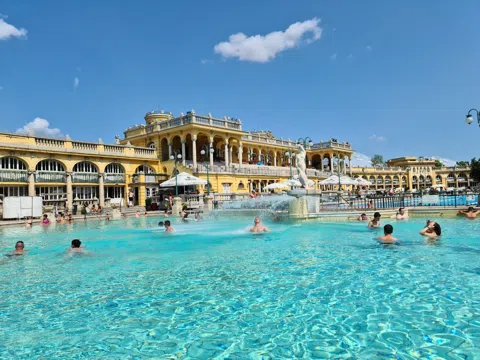
Széchenyi Thermal Bath (City Park, District XIV) is the default first bath and the right one in September, when the three outdoor pools are warm and the air above them is not. A day ticket with a locker or cabin runs HUF 13,500 to 14,500 (around €36 to €38); take the cabin if there are four or more of you, because changing and stowing bags in a shared locker row with a group is where the first hour disappears. Massages start at roughly HUF 35,000 (~€94) as a package, which is a separate decision rather than an add-on. Book the timed ticket online, partly to skip the queue but mainly because one of the city's other grand baths is out of service and the demand has to go somewhere. Groups are welcome, there is no door policy, and nobody will look twice at eight people arriving together. The Saturday night 'Sparty' is a different animal entirely: a separately ticketed over-18s event, not a late swim.


Rudas Bath (Döbrentei tér, at the foot of Gellért Hill on the Buda bank) is the one with the rooftop tub, and that circular pool looking straight up the river is the best-value view in Budapest at around HUF 12,000 (~€30) on a weekday, HUF 13,200 at the weekend. The catch is the schedule. On weekdays the historic Turkish section is single-sex, which will split a mixed group at the door and sour the afternoon; weekends and the rooftop are mixed. Check the day before you go. Night sessions run Friday and Saturday from 22:00 to 03:00 and must be booked online. They pair well with an early dinner, and they make a far better late night than a club if you want to be functional the next morning.
Do the baths on a day you have nothing else booked. Two hours is the minimum that feels worth it, three is better, and the tiredness afterwards is real.
The two tickets that actually sell out

Hungarian Parliament Building (Lipótváros, District V) is the one thing in Budapest that genuinely runs out. Entry is by fixed timed slot in a set language, guided or audio-guided, and the tour is 45 minutes through the grand staircase, the dome hall and the crown jewels. Tickets cost roughly €25 to €36 per adult, with discounts for EU residents and students, and they are sold only through the official partner; anything else is a resale at a markup. September weekend slots go early even though the summer crowds have thinned. If you are a group, book one block together: separate bookings will land on separate slots and you will spend the morning waiting for each other. Security is airport-style, so leave the large bag at the hotel.
Hungarian State Opera House (Andrássy út, District VI) restarts its season in September after the summer dark period, and this is the cheapest grand night out in the city. Seats run from HUF 900 for rear-balcony standing to HUF 25,000 for the good stalls, so a place at the back of the balcony costs about what two coffees do, which is reason enough to take it. Tickets go on sale three to four months ahead, so a party of six needs to book together well before arrival rather than trying their luck at the box office. If the programme does not suit, the daytime guided tour of the building costs around €25 to €30 and takes groups without difficulty.

Views on both banks

Fisherman's Bastion (Castle District, Buda) is the postcard, and the useful detail is the ticket window. The lower terraces are free and open around the clock; the upper towers cost HUF 1,700 (~€4) but are only ticketed between 09:00 and 21:00 through 30 September. Arrive after nine in the evening and you walk up for nothing, with the Parliament lit across the water and a fraction of the daytime crowd. The terraces suit any size of group; the paid towers get tight for large parties.
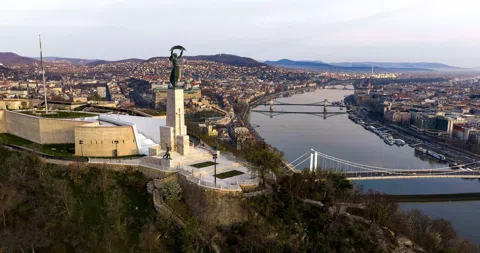
Citadella, Gellért Hill (Buda) reopened in spring 2026 after eleven years behind hoardings, which means most guidebook advice about it being shut is out of date. It is free, unticketed and now open in three directions, with lifts and step-free paths that make it workable with prams, wheelchairs or a group of mixed fitness. The walk up is steep however you approach it, so give it an hour and do it in the cooler part of the day. The 'Bastion of Freedom' exhibition inside the cannon tower is ticketed separately if you want the history, but the terraces outside are the best free panorama in the city.

St. Stephen's Basilica (Lipótváros, District V) is the third viewpoint and the easiest. No timed slots and no booking: walk up and pay HUF 2,600 (~€6) for the church hall, HUF 5,000 (~€12) for the panorama terrace and treasury, or HUF 6,800 (~€16) for both. Take the lift rather than the 304 steps if anyone in the group would rather not climb. The terrace stays open daily until 19:00, later than the church hall itself, which makes it a good stop just before the square below fills with dinner tables. Modest dress inside the hall.

Where to eat without queueing
Great Market Hall (Nagyvásárcsarnok) (Fővám tér, District IX) is free to enter and best treated as a first stop rather than a meal. Go at opening, 06:00 on weekdays, or after 15:00. Mid-morning the ground floor is genuinely crowded and the upstairs food counters are cramped for more than four. Lángos and street food run HUF 1,500 to 3,500. Note the closing times, which catch out weekend visitors: 16:00 on Saturday, and only a fraction of stalls trade on Sunday.

Gettó Gulyás (Wesselényi utca, District VII) is the most honest introduction to Hungarian cooking in the city, with fourteen stews on the menu, rooster and catfish among them alongside the goulash everybody expects. Mains sit at HUF 4,500 to 7,500 (~€12 to €20), it is open daily from noon to 23:00, and it fills fast. Book, particularly for four or more, and particularly on a weekend evening, because it is a short walk from the ruin bars and the whole street is looking for a table at eight.


Stand25 Bisztró (Buda side, a short walk from the Chain Bridge) is the quality bar for Hungarian food without fine-dining prices: Szabina Szulló and Tamás Széll's Bib Gourmand bistro, mains around HUF 7,000 to 12,000, with lunch the better value. The room is small, so book well ahead, expect difficulty above six people, and note it is closed on Sundays.
New York Café (Erzsébet körút, District VII) is expensive and busy and worth an hour anyway. Coffee runs €7 to €8, desserts €10 to €15 and mains €20 to €25, but the 1894 interior is the real thing rather than a restoration in spirit. Reservations open one month ahead and cap at ten people per table; gallery tables can be booked for lunch between 12:00 and 17:00, and walk-ins are possible outside the peak. A mid-afternoon coffee is the cheapest way through the door.

Evenings, from quiet to very loud
Legenda City Cruises (Dock 7, Vigadó tér, District V) runs the one-hour river trip that suits a first visit, sailing between roughly 20:15 and 22:00 with an audio guide in thirty languages and a drink included. Adults pay €25, students €22.50, children aged 10 to 14 €17.50, under-tens free, and cancellation is free up to 24 hours ahead. Group quotes start at eight people. September's earlier sunset is what makes this work: the buildings are lit while the evening is still young enough to eat afterwards.


High Note SkyBar (Hercegprímás utca, District V) puts you level with the Basilica dome, which is the specific reason to pay rooftop prices here rather than at any other rooftop. Cocktails are HUF 4,500 to 6,500 (~€12 to €17). Reserve for evenings, dress smart casual (gym wear and flip-flops are turned away) and call ahead for a large party rather than arriving as one. These are the last comfortable outdoor evenings of the year, so the terrace books out.
Szimpla Kert (Kazinczy utca, District VII) is the original ruin bar, still in the 2004 building, with no door policy, no reservations and no cover charge. Beer is HUF 1,500 to 2,000. Large groups are the norm, but arrive before roughly 21:00 if you want to hold a table. The version locals actually use is the Sunday morning farmers' market, 09:00 to 14:00, when the same courtyard is full of produce and daylight instead of a one-in-the-morning crush.


Instant-Fogas Komplexum (Akácfa utca, District VII) is the largest party complex in Central Europe and the sensible answer to eight people who want different music: six rooms in one building, so the group splits by taste without splitting up. Open daily 18:00 to 06:00, over-18s, ID checked, entry free to low on most nights, drinks HUF 1,500 to 2,500. It is a serious late-night venue rather than a place for a quiet drink, so treat it as the whole evening rather than the end of one.
A workable pattern for a mixed group: cruise at 20:15, dinner at 21:30, then whoever wants the ruin bars goes to District VII and whoever does not walks back over the bridge.
An afternoon upriver
Szentendre (up the Danube, north of the city) is the day trip that does not eat the day. The suburban HÉV H5 leaves Batthyány tér every twenty minutes and takes about forty; the fare is a HUF 350 city ticket plus a HUF 310 supplement each way, roughly €2 in total. Buy the supplement at Batthyány tér or Margaret Bridge before boarding, because inspectors do check past the city boundary and the fine is not worth the saving. No booking is needed for anything, groups travel independently, and the town itself, riverside and baroque and walkable in an afternoon, costs nothing to wander. Go in the morning, be back in Budapest by mid-afternoon, and you still have the evening.

Practical notes
The metro, trams and buses run on one integrated ticket system; a single ride is HUF 350, and a 24- or 72-hour travelcard pays for itself quickly if you are crossing the river more than twice a day. Validate before boarding. Tram 2 along the Pest embankment is the cheapest sightseeing in the city. Most of central Pest is flat and walkable; Buda is not, and the hills are steeper than the map suggests.
Cards work almost everywhere, including market stalls and the baths. Keep a small amount of forint for tips, the HÉV supplement and the lángos counter. Prices are quoted in forint by law, so if a menu leads with euros, expect a poor rate. Refuse currency conversion at the terminal and pay in forint. Tipping is typically ten per cent; check whether service is already on the bill.
Book Parliament and the Opera before you travel, the baths and any rooftop or restaurant table a few days ahead, and leave the viewpoints and the market entirely unbooked. Weekday mornings are the calmest hours everywhere. Sunday closes more than visitors expect, the market included.
Excluding the room, a comfortable day runs around €70 to €90 a head: a bath at €36, a mid-range dinner at €20, a couple of drinks, transport at a few euros. A frugal day is closer to €35 if you lean on the free viewpoints, the market and a rear-balcony seat at the opera. A rooftop evening and a Bib Gourmand dinner will push you past €120.
For more on the districts, seasons and getting around, see the full Budapest guide. Book the two things that sell out, and leave the rest of the days loose.
Before you go
Is September a good month for a first visit to Budapest?
It is the easiest month. Afternoons usually sit in the low twenties Celsius, the outdoor pools at Széchenyi are still warm, and the summer queues have thinned. The main adjustment is light: sunset falls from just after 19:30 on 1 September to around 18:45 by the 30th, so evening cruises and rooftop drinks happen at a civilised hour. Pack a layer for after dark.
Do I need to book Parliament tickets in advance?
Yes. The Hungarian Parliament Building is the one attraction in Budapest that really does sell out, including on September weekends. Entry is by fixed timed slot in a set language, tickets cost roughly €25 to €36 per adult, and they are sold only through the official partner. If you are a group, book one block together, because separate bookings land on separate slots.
Which thermal bath should a first-timer choose?
Széchenyi in City Park is the default: large warm outdoor pools, no door policy, easy for groups, at HUF 13,500 to 14,500 with a locker or cabin. Rudas on the Buda bank is cheaper, around HUF 12,000 on a weekday, and its rooftop tub has the best view in the city. Check the Rudas schedule first, though, because on weekdays the historic Turkish section is single-sex, which splits a mixed group.
How many days do I need in Budapest?
Three full days covers the city without rushing: one for Pest and the Parliament, one for Buda's hills, one built around a bath. A fourth day lets you add Szentendre upriver and keep a morning free. If Budapest is one stop in a longer European trip, three nights is the honest minimum; two means one of them goes on logistics.
Is Budapest a cash or card city?
Cards work almost everywhere, including the baths and most market stalls, but keep some forint for tips, the HÉV supplement to Szentendre and street-food counters. Prices are quoted in forint, and if a menu leads with euros the rate will be poor. Always decline currency conversion at the card terminal and pay in forint.