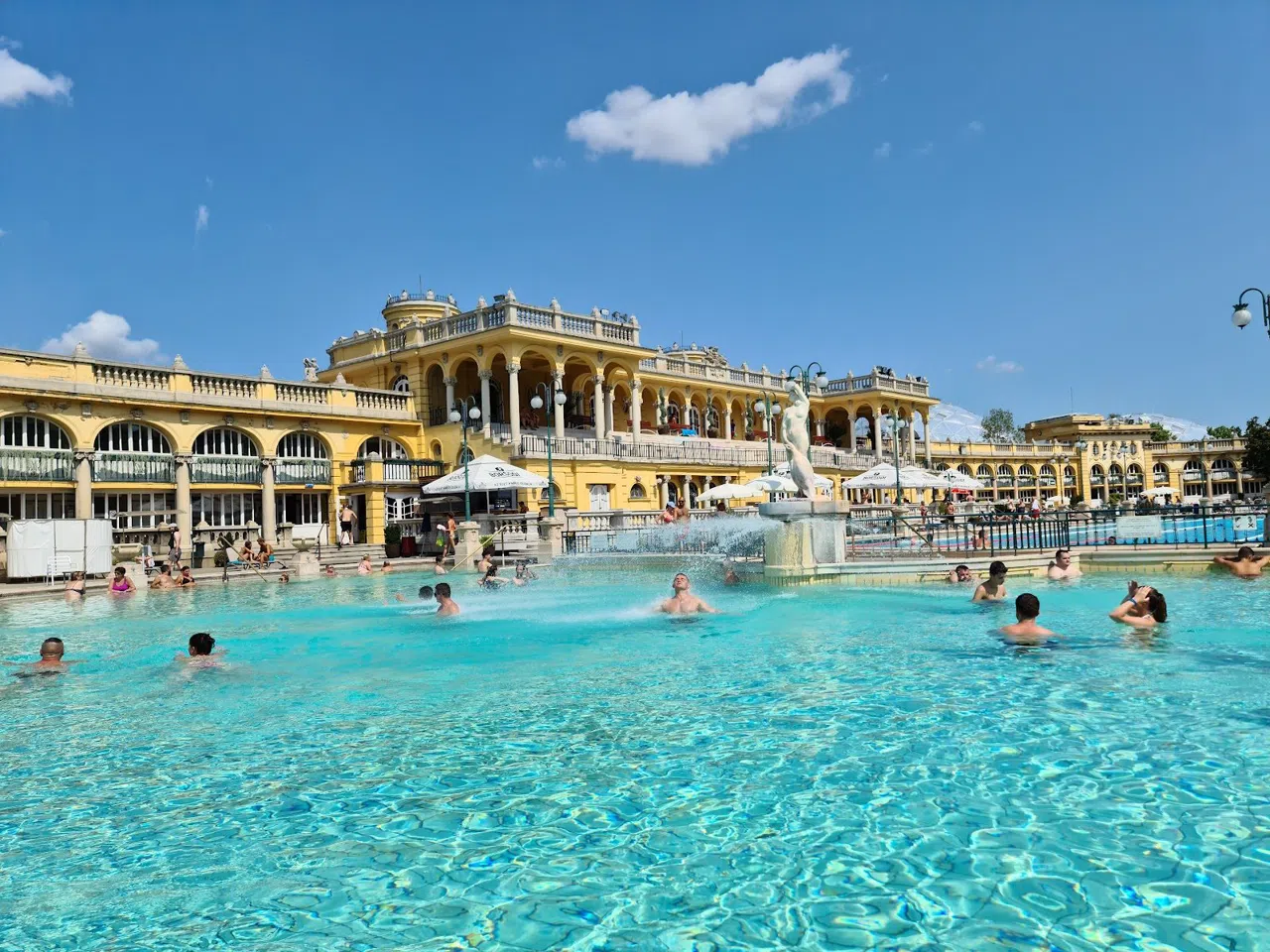

In Budapest, the day does not begin with coffee. It begins with water — mineral-rich, springing from underground reserves that have drawn bathers to this bend in the Danube since the Roman garrison town of Aquincum. Chess boards balance on floating trays in the outdoor pools of the grand baths, ruin bars empty into all-night bathing sessions, and a weekend here is measured less in sights ticked off than in hours spent submerged. This is a guide to that rhythm: the imperial pools of Pest, the Ottoman relics of Buda, the neighbourhood baths where locals actually go, and the specifically Budapest habit of turning a night out into a night in the water.
The Imperial Bath: Chess, Steam, and Crowds at Széchenyi
Széchenyi Thermal Bath (City Park, Pest) is the image most people already have of Budapest bathing before they arrive: a Neo-Baroque palace, built in 1913, wrapped around three outdoor pools where retirees play chess on floating boards while steam rises off the water even in winter. It is the largest bath in Europe by capacity, and it is built for it — this is the one bath on this list that genuinely absorbs a large group without anyone feeling the squeeze, with indoor thermal halls, saunas, and steam rooms running off the main courtyard.
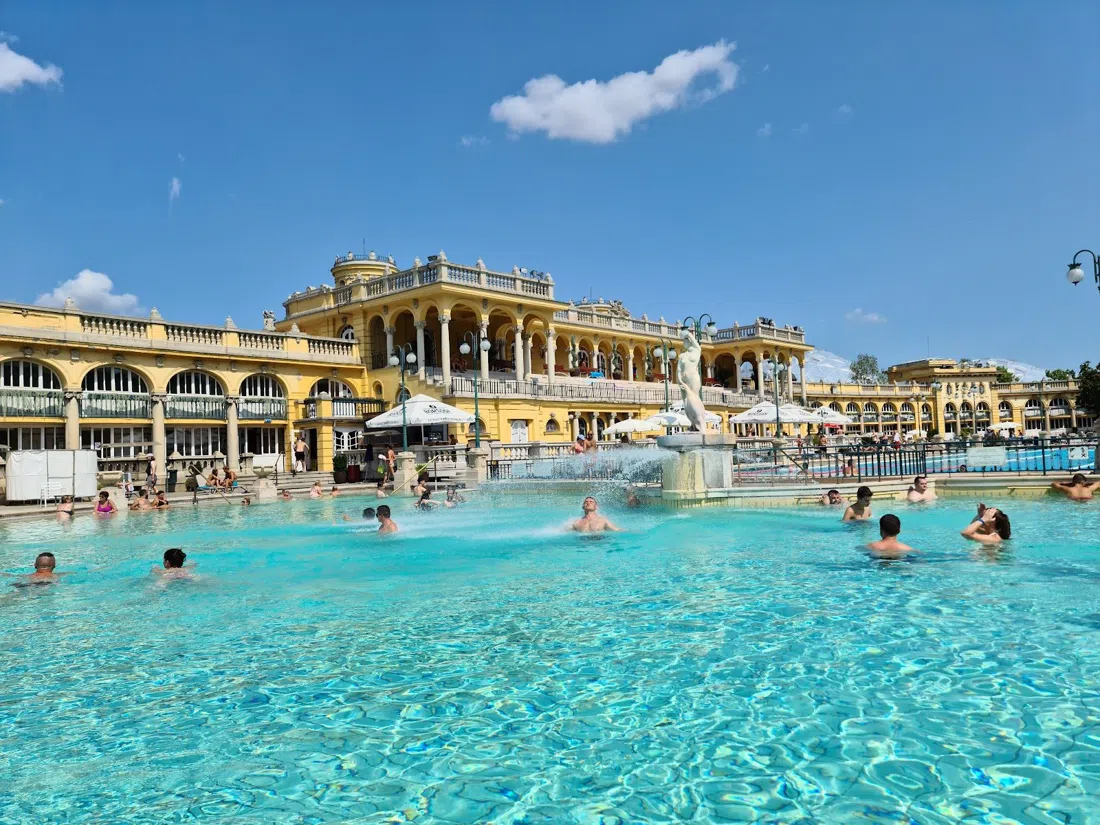
A day ticket runs roughly HUF 8,000–14,000 (about €20–35) depending on cabin or locker and weekday or weekend. Go early — doors open at 6am on weekdays — if the chess-players-in-steam photograph matters to you; by midmorning the outdoor pools are full of tour groups and the atmosphere shifts from contemplative to convivial. Note that as of August 2025, Széchenyi enforces a 14+ age minimum for daytime bathing, a change worth knowing if you are travelling with younger children — Paskál, below, has no such restriction.
On Saturday nights the character of the place changes entirely: the Sparty and Cinetrip club events turn the same pools into a DJ-lit party, with tickets from around HUF 12,000. These nights are strictly 18+ and photo ID is checked at the door — this is not the daytime family bath, and it should not be booked as if it were. It is, however, the natural endpoint of an evening that starts in the ruin bars of the Jewish Quarter (more on that below), and it is worth booking online in advance, since the popular dates sell out.
Ottoman Budapest: Rudas and the Last Authentic Turkish Baths
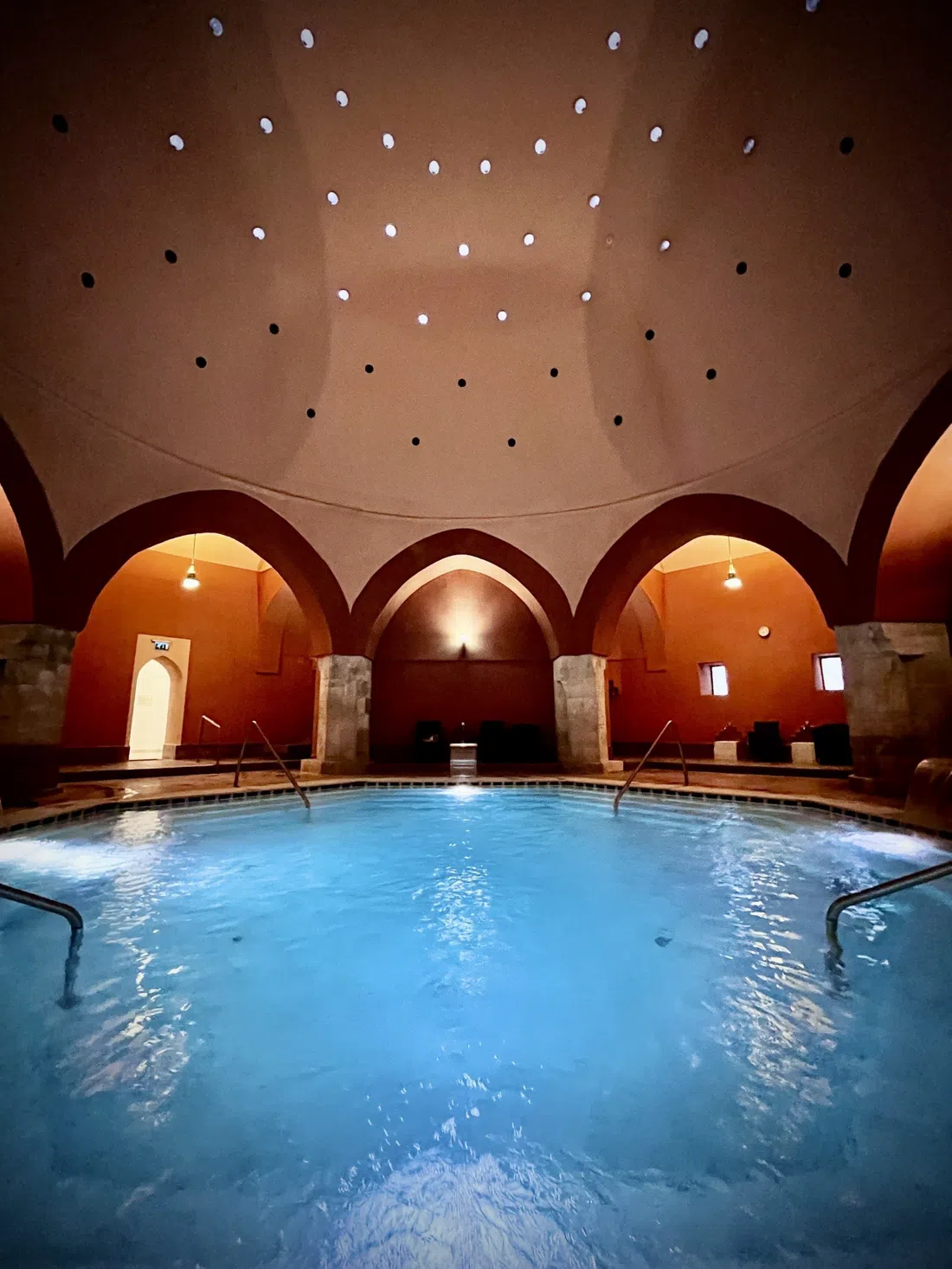
Cross the river to Buda and the character of bathing changes again. Rudas Thermal Bath, at the foot of Gellért Hill by Elizabeth Bridge, is the most intact working Ottoman bath left in the city — its octagonal domed hall dates to 1550, and bathing under that original stonework, with shafts of light falling through the pierced dome onto an octagonal pool, is a genuinely different experience from Széchenyi's grandeur. By day it suits small-to-mid groups well; a day ticket costs around HUF 8,000 (about €20).
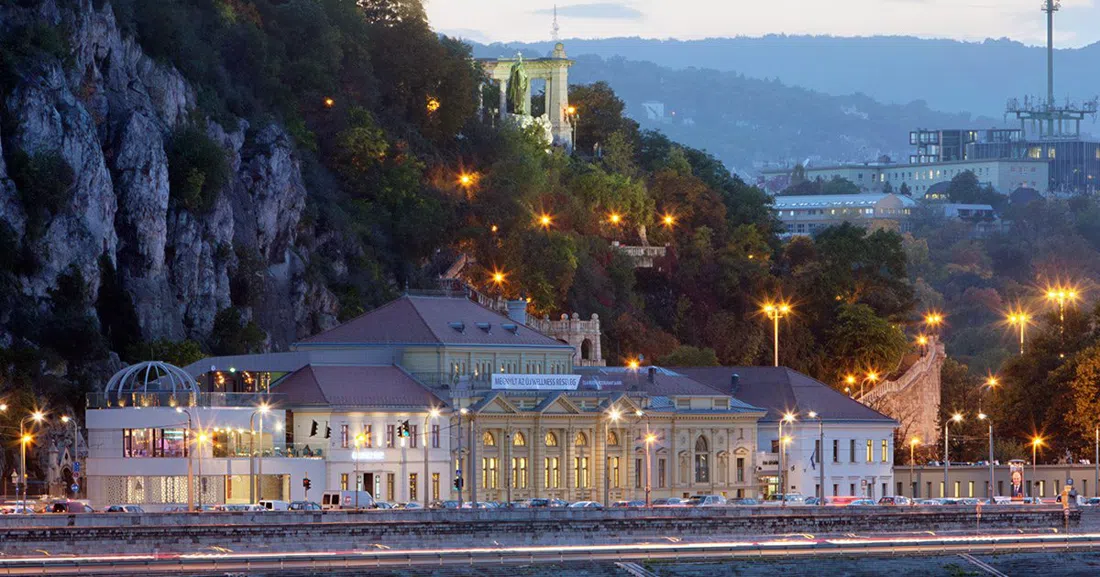
What makes Rudas distinctive is its Friday and Saturday night session, 22:00 to 03:00, which is mixed-gender and open to everyone — a genuine night bathe, not a club night, with a ticket around HUF 15,000 (about €39). There is no DJ, no photo-ID door policy beyond the standard 14+ age minimum, and no party atmosphere to speak of; it is simply the same domed pool, lit differently, at an hour when the water feels earned rather than performative. For couples or smaller groups who want the Ottoman bathhouse experience without a club soundtrack, this is the better choice over a Széchenyi Sparty night.
A short walk from Lukács (below), Veli Bej Bath sits in the II district, run by the Hospitaller Brothers hospital next door — a working medical facility as much as a tourist site, low-key and unhurried, with a day ticket around HUF 3,900–4,900 (about €10–13). Since Gellért's closure in 2025 and the stalled renovation at Király, Veli Bej has become one of the last genuinely authentic 16th-century Ottoman baths still open to visitors in Budapest, and it suits small groups who want that history without Rudas's crowds.
Where Budapesters Actually Bathe
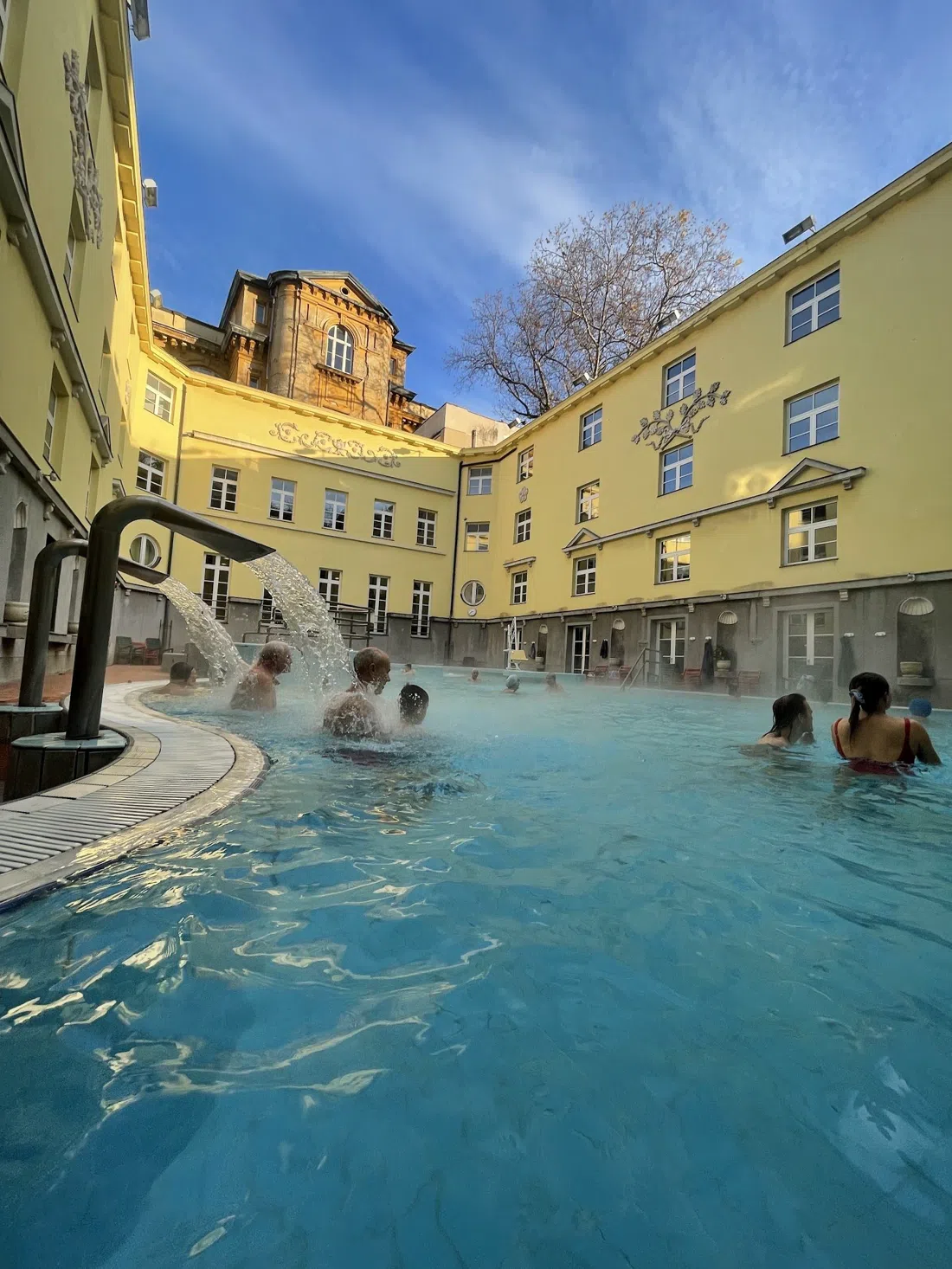
Strip away the tour-group circuit and the city's own bathing habits look different — quieter, cheaper, and closer to home. Lukács Thermal Bath, on the Buda side near Margaret Bridge, is Art Nouveau rather than Ottoman or imperial, and it is where a large share of locals actually go for a Tuesday evening soak, since it stays open until 22:00 on that day. A day ticket costs around HUF 6,600 (about €17), and it is markedly less touristed than Széchenyi or Rudas — this is the closest thing on this list to how Budapest bathes on an ordinary weeknight.
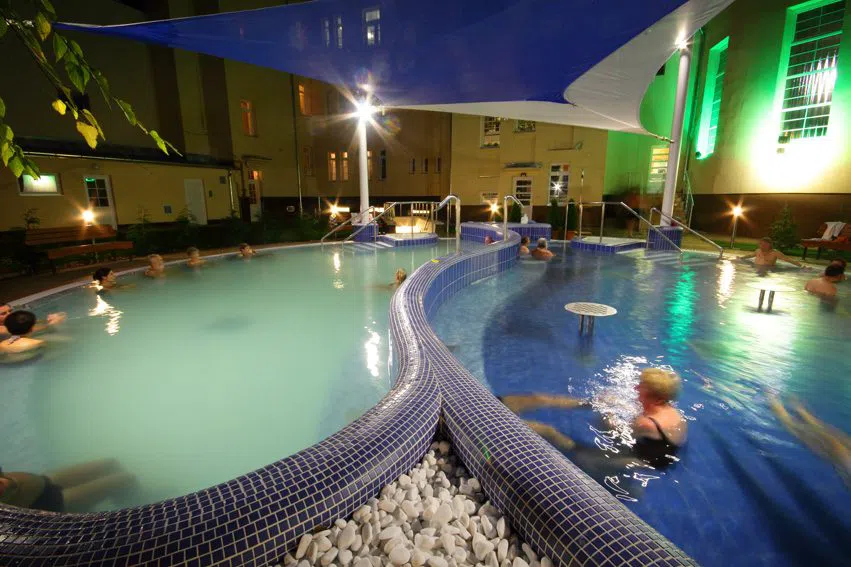
Across the river in Ferencváros, District IX, Dandár Thermal Bath is smaller again — an intimate neighbourhood bath, rarely crowded, and the cheapest entry on this list at around HUF 3,500–4,000 (about €9–11). It suits small groups or a couple who want a quiet counterpoint to the grand imperial baths without any performance of grandeur at all.
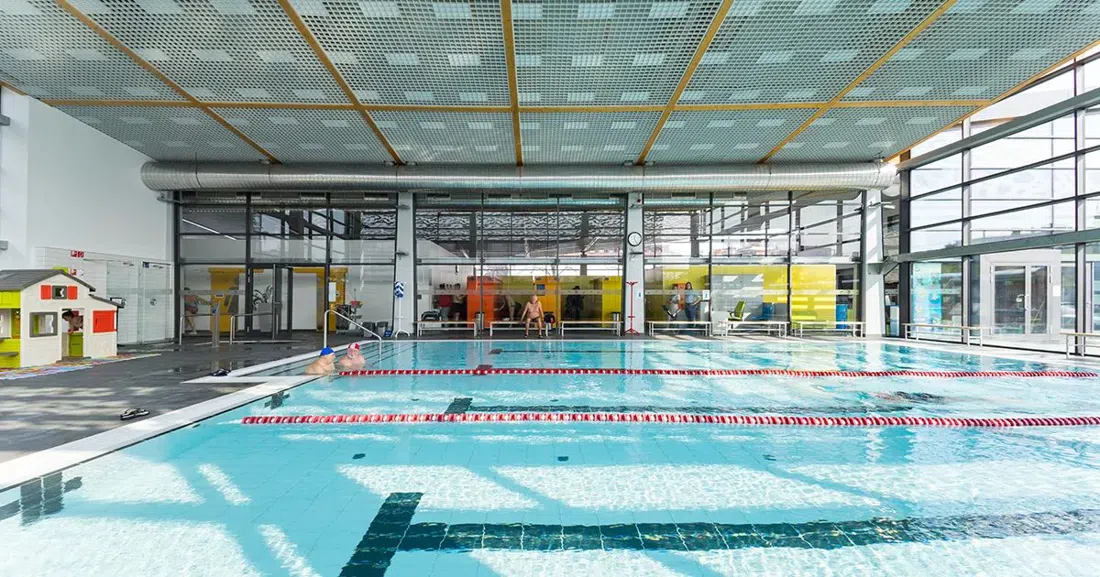
Out in Zugló, District XIV, Paskál Thermal Bath is the youngest bath in the network, expanded in 2016, modern in feel and with no age restriction — a practical, family-friendly alternative while Gellért and Király sit closed, with tickets in the HUF 4,000–6,000 range (about €10–16). And in District III, Csillaghegyi Árpád Bath is a genuine hidden gem in the Csillaghegy area of Óbuda — rarely tourist-crowded, good for groups, and priced around HUF 3,000–5,000 (about €8–13). If the "dawn to midnight" idea of this piece means anything practical, it is that a morning here, away from the centre, is what an unhurried Budapest bathing day actually looks like before the tour buses start moving.
Summer Only: Palatinus Strand on Margaret Island
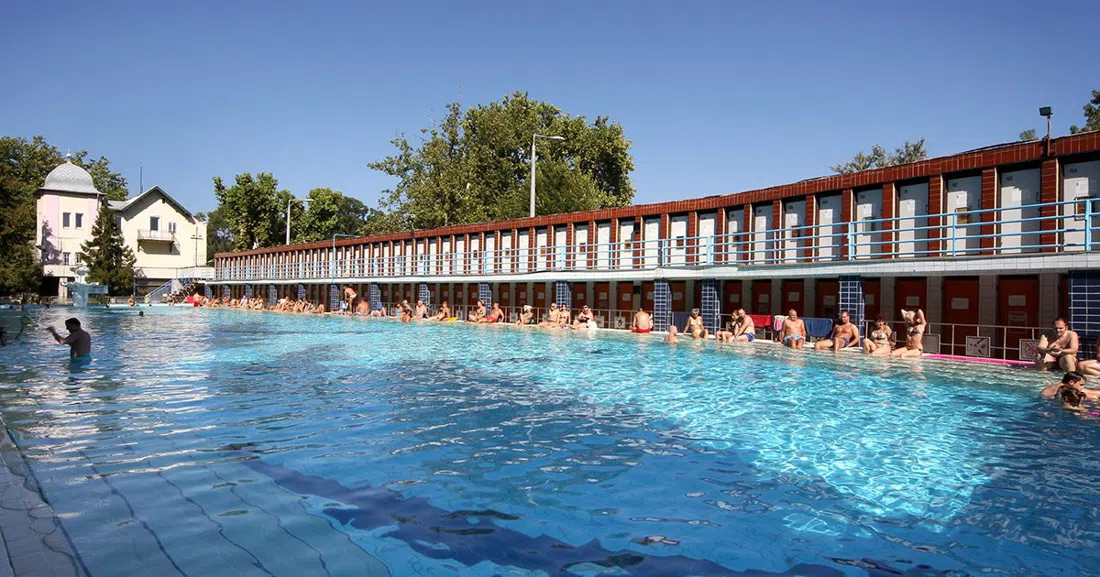
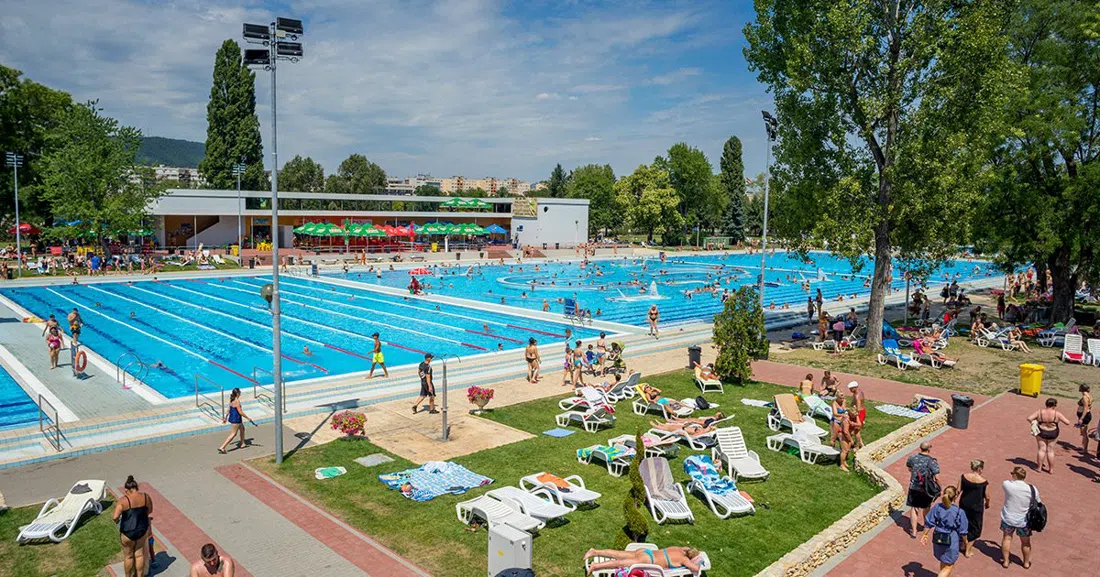
The one entry here that is not a thermal bathhouse but an outdoor pool complex, Palatinus Strand on Margaret Island is seasonal — open roughly from late May through early September — and it is the daytime, family-and-friends counterpoint to everything after-dark on this list. It is enormous and built for capacity, with tickets around HUF 6,000–6,500 (about €16–17.50) and no age restriction, and on a hot July afternoon it fills with exactly the mix of families, students, and groups of friends that the night-bathing scene at Rudas and Széchenyi does not attract. If your Budapest weekend falls in summer, this is where the day ends before the ruin bars open.
The Ruin-Bar-to-Bath Pipeline
No account of Budapest nightlife is complete without the ruin bars, and no account of the ruin bars is complete without acknowledging where they feed. Szimpla Kert, in the Jewish Quarter of Erzsébetváros, opened in 2002 and is the original of the genre — a courtyard bar built into a half-derelict building, its walls a collage of salvaged furniture and street art, its scale large enough to absorb a group without a booking. There is no cover charge; you pay for drinks as you go, and you can walk in any night of the week.

A short walk away, Instant-Fogas is the largest ruin-bar complex in the city, a maze of rooms and courtyards built explicitly for volume — stag and hen parties are a normal Friday night here, entry is free, and again you pay only for what you drink. It is the natural late-night anchor for a group before or after a Rudas night session or a Széchenyi Sparty night: start in the ruin bars around 22:00, move to the water at midnight or later, and the two halves of a Budapest weekend — the loud half and the submerged half — stop feeling like separate itineraries.

This pipeline is worth being honest about rather than romantic: Sparty and Cinetrip nights at Széchenyi are explicitly built around exactly this crowd, which is why the door checks photo ID and enforces 18+ strictly. Rudas's night session, by contrast, draws a genuinely mixed crowd of locals and visitors rather than a stag-do overflow, which is worth knowing if a quieter after-dark soak is what you actually want.
Practical Matters
Transport. Széchenyi sits on the M1 (yellow) metro line, the oldest on the continent, with a stop directly outside. Rudas, Lukács, and Veli Bej are all on the Buda embankment and reachable by tram 19 or 41 or the connecting buses along the river; a taxi or rideshare from central Pest to any of them runs 10–15 minutes. Palatinus Strand is on Margaret Island, reached by tram 4 or 6 to the bridge and then a short walk or the island bus. Paskál and Csillaghegyi Árpád are genuinely local trips — a bus or, for Csillaghegy, the suburban HÉV line — and worth the half-hour if you want a bath with no tour groups at all.
Cash. The larger baths — Széchenyi, Rudas — take cards without issue, but bring some HUF in cash regardless: locker deposits, towel and robe rental, and the smaller neighbourhood baths such as Dandár, Csillaghegyi Árpád, and Veli Bej are more comfortable with cash than card.
Timing. Locals bathe early — Széchenyi opens at 6am on weekdays and the outdoor pools are at their best, both visually and atmospherically, before 9am. Tour groups arrive from mid-morning onward. If a bath is your priority rather than a backdrop, plan the morning around it and save the afternoon for everything else.
Budget. A single day of bathing at one of the grand baths plus a locker or cabin runs roughly €20–35; a night session at Rudas adds another €39 on top of that if you're doing both in one trip. The neighbourhood baths — Dandár, Csillaghegyi Árpád, Veli Bej — are a fraction of that, often under €13, and worth building into a longer stay precisely because they don't need to be pre-booked or planned around. For where to base yourself for easy access to both the Buda baths and the Pest ruin-bar district, start with a Budapest hotel search, and for the rest of the city beyond the water, see the full Budapest guide.